
By BoDuan ·
Bottom Feed vs Top and Bottom Feed on a Bell Knife Skiver
Start with the parts you need to skive. A lower feed roller and a fixed presser foot are worth testing on flexible leather that turns easily. For stiff or laminated pieces that hesitate under the foot, ask to test a driven upper roller as well. Choose the setup that follows your line, reaches the skive target and leaves a surface you can use.
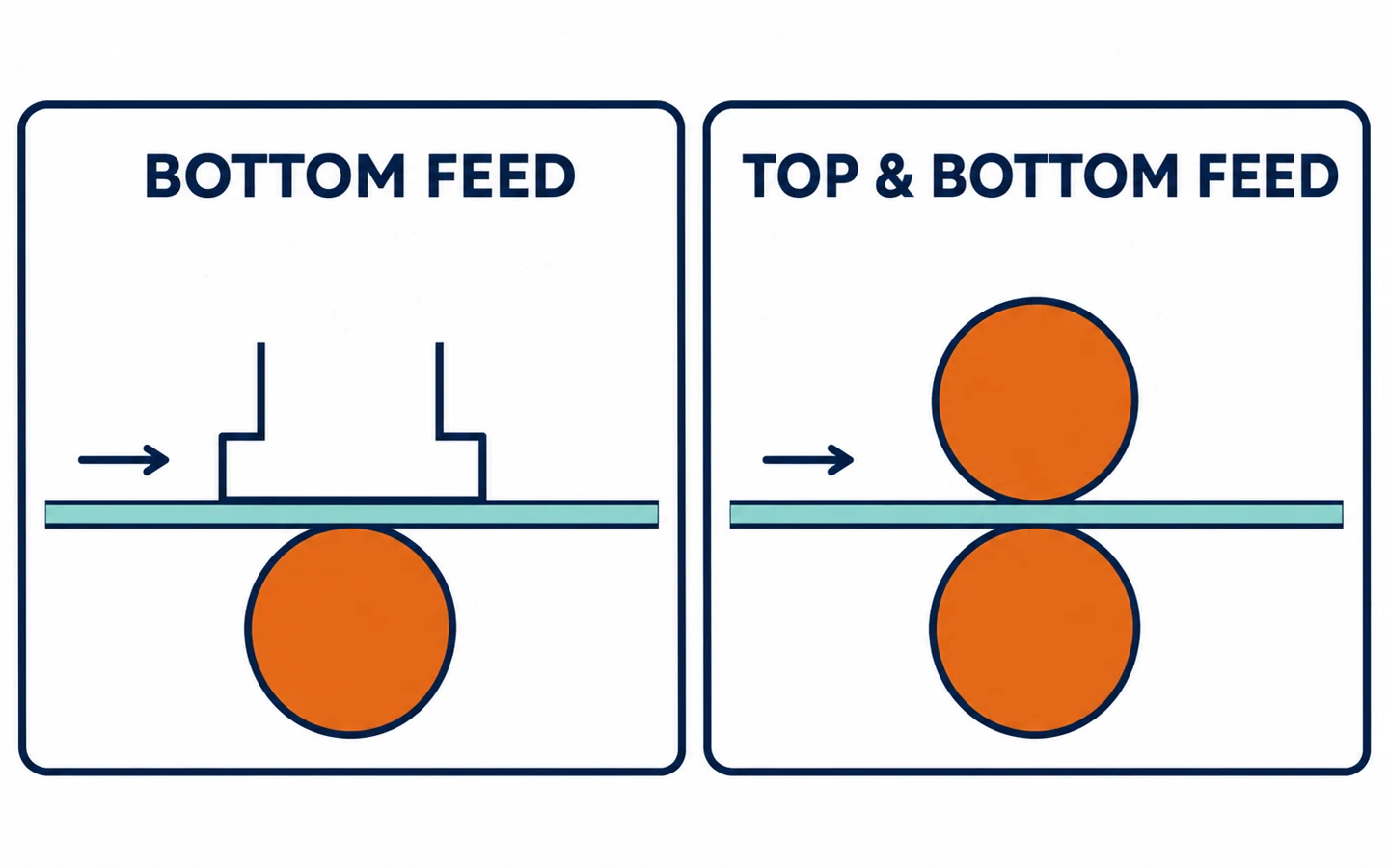
Orange marks the driven surfaces in these simplified examples. The knife and other machine parts are omitted so the feed contact is easy to see.
Which surfaces actually move the leather?
In a bottom-feed setup, the driven lower roller moves the work under a presser foot. A top and bottom feed setup adds a driven upper contact. An upper roller that turns freely against the moving leather is a guide or pressure element. Ask the supplier to identify each driven roller and show its drive on the quoted configuration. On some specialised machines the maker specifies a driven guide roll. Fortuna’s configuration table gives examples for toe puffs, counters and other stiff materials.
Feed position and feed speed are separate choices. Once you know which contacts drive the work, check whether the operator can change feed speed while keeping the knife at its setting.
Compare the edge and both faces of the sample
Ask the supplier to match the target cut on both machines. Run matching pieces with the same grain orientation. Use one straight piece to check the skived band, then use the full-size curve to see whether the piece can turn without creeping sideways. Mark any hesitation at the entry, push near a stiff joint, or change in remaining thickness after the turn.
Check both faces for roller tracks or glazing, especially on coated leather. If the upper drive helps the part advance but leaves a visible mark, ask what roller surface or pressure options are available and request a second sample. Review the BD-102 machine and demonstration and check the actual feed arrangement with the quotation.
What to send for a skiving trial
Send a straight blank and the most difficult full-size curved part, with the finished face identified. Mark the target remaining thickness and skive width. Ask for labelled samples and a short view of each part entering, turning and leaving the quoted feed setup.
Use the width and thickness measuring guide and the sample preparation checklist.
Discuss a BD-102 leather edge skiving trial →