
By BoDuan ·
How to Choose a Leather Splitter Working Width
Lay the largest production blank flat in the direction it will travel through the machine. Measure its widest span across that direction, including tabs and temporary trim. Choose a working width that leaves room to guide the actual blank and confirm the fit with a trial.
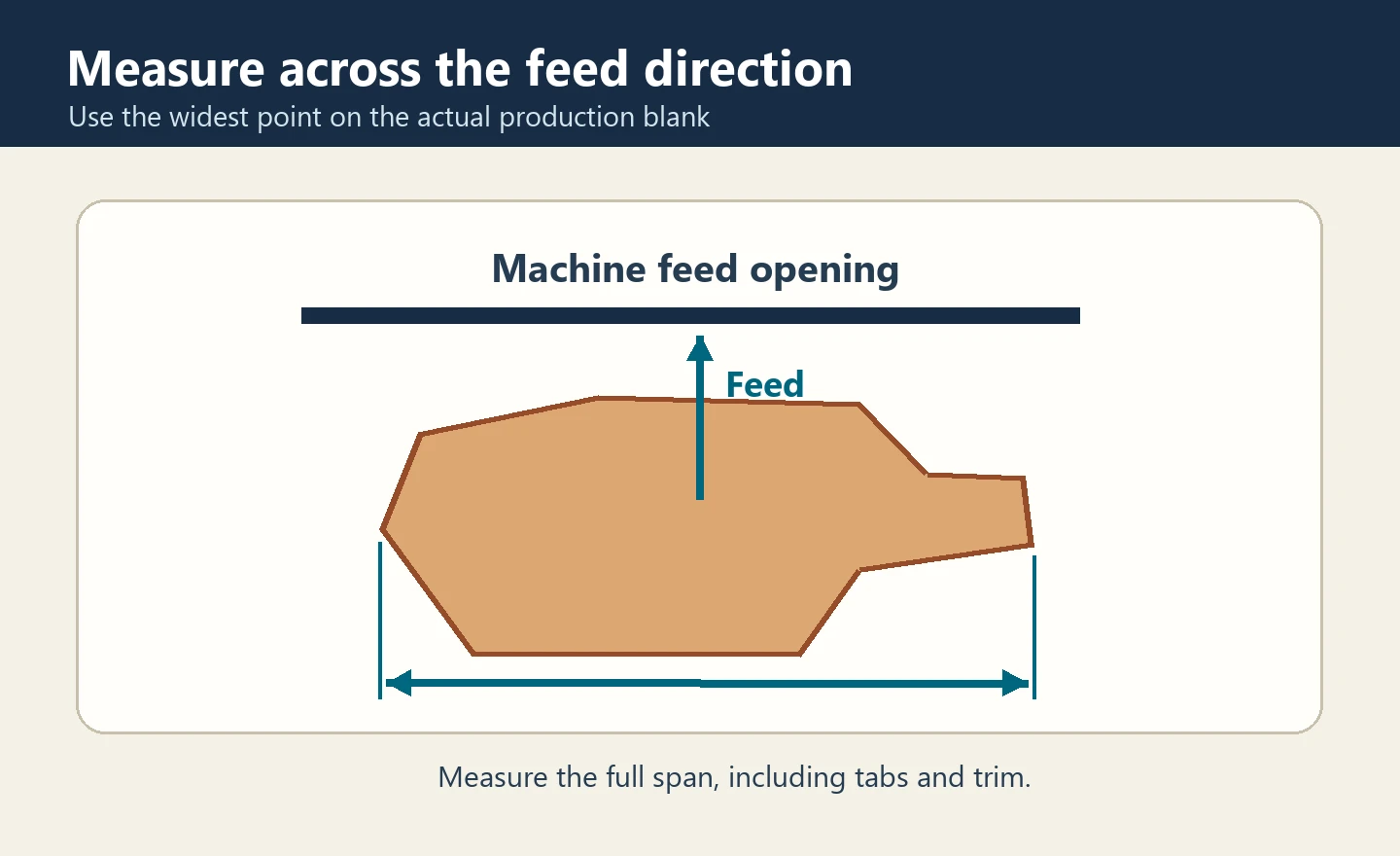
Feed direction determines which span counts as the width. Check the entire outline, including a shoulder or tab that arrives later in the pass.
How do you measure an irregular leather blank?
Place a straight reference line parallel to the feed arrow. Find the two outermost points across the feed direction and measure between them. Do this for the actual blank you will feed, which may differ from the finished pattern. If you plan to rotate the blank, verify that the material orientation, table support and feed behaviour are acceptable in that direction.
When is 300, 420 or 520 mm worth comparing?
- BD-300, 300 mm. Compare it for pre-cut pieces whose widest blanks leave usable guiding room inside the opening.
- BD-L420W, 420 mm. Compare it when a larger bag or footwear panel approaches the limit of a 300 mm machine before trimming.
- BD-L520W, 520 mm. Compare it when your largest production blanks need additional width or support. Confirm the compatible incoming thickness and feed configuration for your stock.
For example, a blank that measures 305 mm across the planned feed direction exceeds a nominal 300 mm opening. Reorient it only if the process allows it, or test it on a wider machine. A blank close to the listed limit deserves the same trial because handling room depends on the outline and feed setup.
What should the full-width trial verify?
Run the widest real blank, following the supplier’s operating guidance. Measure the finished thickness near both sides and the centre at the same point along the part. Repeat near the leading and trailing ends if those areas stay in the finished panel. Record entry or exit marks, drift and whether the part needed extra support. Compare the dimensions with your tolerance.
If the rest of the panel already meets the specification and only a seam margin needs thinning, see edge skiving versus whole-panel splitting.
What to send for a splitting trial
Send your widest full-size blank and a second blank in the thickest expected stock. Mark the feed direction and the required face. Include the input and target thickness, tolerance and expected batch volume. Ask for the split samples back with thickness readings across the width.
Discuss a leather splitting trial →